Showing posts with label The Health Care Blog. Show all posts

Thursday, November 12, 2020

THCB Gang Episode 32 LIVE 1PM PT/4PM ET

Episode 32 of “The THCB Gang” will be live-streamed on Thursday, November 12th. Tune in below!

Matthew Holt (@boltyboy) will be joined by some of our regulars: WTF Health Host Jessica DaMassa (@jessdamassa), radiologist Saurabh Jha (@RougeRad), MD-turned entrepreneur Jean-Luc Neptune (@jeanlucneptune), communications leader Jennifer Benz (@jenbenz), THCB’s Editor-in-Chief me (zoykskhan) and guest Jeff Goldsmith, President of Health Futures, Inc and National Advisor, Navigant Healthcare. The conversation will follow the post-election frenzy around COVID-19 response, ACA, and what a Dem. president means for the United States in terms of health care.

If you’d rather listen to the episode, the audio is preserved as a weekly podcast available on our iTunes & Spotify channels — Zoya Khanproducer


from The Health Care Blog https://ift.tt/35pxmRN
via IFTTT

In Praise of Unsung Heroes

By KIM BELLARD

Even in this extraordinary year, this has been an extraordinary week.  Last Tuesday we had what many believe to have been the most important Presidential election in recent times, maybe ever.  The week also found the coronavirus pandemic reaching new heights.  That was the week that was.

What struck me, though, is how both our election systems and our healthcare system rely on “ordinary” people to keep them going.  They’ve never been more extraordinary than this year.

The pandemic first impacted voting earlier in the year, during primary season.  Going to the polls suddenly seemed like potentially a life-threatening choice, and working at them practically suicidal.  Dates of primaries were moved, many polling stations were closed, new voting procedures were put into place, and absentee ballots found a new popularity.  And yet people turned out in droves to vote, often standing in line for hours.

President Trump upped the ante by constantly railing against absentee ballots and warning about voter fraud.  Despite this, or perhaps because of it, record numbers of people voted early, in person or by mail.  Several states had surpassed 2016 numbers of voters before Election Day.   Tens of millions more showed up on Election Day.  And, amazingly, Election Day passed with relatively few incidents.

Then the counting started. 

We’re a week in and races in several states have yet to be called, and have lack of agreement from most Republicans about some of the ones that have been called.  We have an apparent President-elect but no concession from the current President or other Republican “leaders.”  Instead, they utter the bromide that we should count the legal votes, not count the illegal votes, and let the judicial process play out.

As is always true, but especially during the pandemic, the election would not have been possible without poll workers.  With older people both being more at risk for COVID-19 and being the majority of the election workforce, it wasn’t initially clear there would be enough workers. 

Calls went out for young people to become poll workers – and they responded.  Organizations like Power the Polls and Poll Hero Project recruited over 650,000 new workers, most of them under 65 and many of them students.

“I just felt that I had to do something,” one student worker told The New York Times.   Another told The Christian Science Monitor:

There are a lot of stereotypes about my generation: We’re lazier, not connecting to the real world. We’re zombies to social media and our phones and stuff.  But this has truly shown me that is just not at all true. There are so many people my age who are just looking for any opportunity to get involved.”

Election Assistance Commission chairman Ben Hovland told Time: “Poll workers are really the unsung heroes of our democracy.” He’s right.

But, of course, once all those votes are cast they have to get counted, and that leads to a second group of unsung heroes of democracy.  Those are the people sitting in those drab offices and warehouse deciding which ballots are valid and ensuring they get properly counted.  They’re set up as bipartisan teams, usually with election observers watching the process. 

In 2020, unfortunately, they’re the ones also risking catching CIVID-19 in the close quarters and getting threats of physical violence, even death threats.  The President and his allies are constantly questioning their motives, challenging their tallies and gathering outside counting spots to protest. They’re demeaning the hard work and long hours the workers have been putting in. 

One nonpartisan poll watcher saw partisan observers harassing election workers, telling WaPo:

That was the most heartbreaking part.  I felt for those workers. I could only imagine what it would feel like, trying to do your job, having these people hover and sneer at you and yell at you and make something so simple, something that’s supposed to be so patriotic, so hard.

Despite all that, the Registrar in Clark County (NV) spoke for all his compatriots, insisting to WaPo: “We’re going to be okay.  We’re going to continue to count. We will not allow anyone to stop us from doing what our duty is.”

“It’s a risky thing to do, but it’s essential work,” one such worker proudly told NYT

Meanwhile, the U.S. is nearing 10 million COVID-19 cases and a quarter of a million deaths, setting new daily records for cases and hospitalizations, both nationally and in a majority of states.  ICU beds are in short supply, as is PPE.  As bad as the spring was in the northeast, the fall is proving to be just as frightening, and the winter threatens to be even worse.

Speaking of unsung heroes, the last count – well over a month ago — for health care worker deaths from COVID-19 topped 1,700 in the U.S. alone. 

Health systems are again resorting to recruiting contract health care workers, often from other states USA Today reports: “Hospitals in nearly every state are recruiting contract nurses to fill shifts,” often paying “crisis rates.”  One emergency room physician added: “Pretty much every nurse who wants a job right now in the United States has a job.”

These are the workers whom President Trump accused of falsely inflating COVID-19 counts in order to get paid more.  It’s not clear if he was including the Walter Reed staff who saved his life when he contracted COVID-19.   

“Trump has insulted our integrity and allowed for more than seven months of chaos and excessive deaths (due) to COVID,” one ER physician told CNBC.  Another lamented that so many still voted for President Trump: “I really thought that our experiences in the trenches would impact people’s voting decisions.” 

The poll workers showed up to work.  The ballot counters showed up to work.  The nurses, medical technicians, aides, doctors, pharmacists, and other healthcare workers showed up for work.  It isn’t always, or even usually, glamorous, and, for most of them, it’s not even particularly well paid. But they do it anyway, despite the risk of COVID, despite the criticisms, despite even the threats,

The least we could do is to be grateful, and not make their jobs even harder.  Let’s make them unsung no more. 

Kim is a former emarketing exec at a major Blues plan, editor of the late & lamented Tincture.io, and now regular THCB contributor.


from The Health Care Blog https://ift.tt/3niwiFE
via IFTTT

Wednesday, November 11, 2020

#Healthin2Point00, Episode 166 | $100 million, scandal, & more

Today on Health in 2 Point 00, we have scandal, drama, intrigue, $100 million and murder! Wait, no; not murder. On Episode 166, we catch up on more deals before Jess gets carried away again. The $100 million goes to Carbon Health in a Series C, which is another Bay Area-based primary care startup; they’re doing a lot of work in COVID testing and growing fast. Next we have many health plans uniting with Cigna Ventures, Humana, and Anthem all investing in Buoy Health which just raised $37.5 million in a Series C. That leads us to a scandal with the former CEO of Navigating Cancer suing Merck’s Global Health Innovation Fund. Finally, in the world of DTx, NightWare has received FDA clearance for its Apple Watch app designed to wake people with PTSD up from nightmares. —Matthew Holt


from The Health Care Blog https://ift.tt/3nbf6BR
via IFTTT

Saturday, November 7, 2020

What Will Shape Joe Biden’s Health Care Agenda?

I’m thrilled to have health futurist Jeff Goldsmith back on THCB, and given Biden was only confirmed as President-elect this morning, his article on what to expect is extremely timely!–Matthew Holt

By  JEFF GOLDSMITH

The Trump administration’s health care journey began with a trillion dollar near miss–the failed Repeal and Replacement of ObamaCare- and ended with a full-on train wreck, the catastrophically mismanaged COVID epidemic that will have claimed 300,000 lives by the time he leaves office. After four years of posturing and lethal incompetence, it will be a relief to see caring and professionalism return to the White House health policy under President-Elect Joe Biden.   

Like Inheriting a Badly Managed World War

Like Barack Obama, Joe Biden will be saddled at the beginning of his regime with a damaged national economy. He will also walk in the door to the immediate need to manage the greatest public health catastrophe in a century as well as its economic consequences–a deep and enduring recession. Biden will be inheriting the equivalent of a badly managed World War we are presently losing.

Public health professionals who were marginalized by Trump will be challenged not only to craft coherent policy to contain and extinguish COVID  but also to sell it to a frightened and polarized general public, many of whom reject the need for basic public safety measures.    

Controlling COVID and rebuilding the critical public health agencies–CDC and FDA–that have damaged by political meddling will consume the lion’s share of the administration’s health policy bandwidth in its first year. It will be pressed to address a huge readiness gap–from critical PPE supplies to the development and deployment of testing and tracing capability to public health co-ordination and messaging–for the next pandemic. Increasing the presently inadequate level of public health funding (less than $100 billion a year in a $21 trillion economy) seems inevitable.

The inability of Congress to produce a fall round of COVID relief will create pressure on Biden to take immediate action to help struggling sectors of the economy, like airlines, restaurants and hospitals, as well as further help for the long term unemployed. Only a little more than half of the 22 million jobs lost in the spring have returned by November. Twenty million Americans were stranded by the July expiration of supplemental unemployment benefits as well as countless millions more “free agents” and contractors not eligible for traditional unemployment that are losing coverage at the end of the year. Mortgage, credit card and consumer loan forbearance are ending, and unless Congress acts, acres of rotten credit will turn rapidly into a banking and bond market crisis which the Federal Reserve cannot fix by itself.   

State governments face FY21 deficits equaling $500 billion over the next two years , against a current annual spending base of about $900 billion.  Further assistance to state and local governments will almost certainly include an additional increase in the federal match for Medicaid (FMAP), beyond the 6.2% temporary increase passed in March). Medicaid enrollment will likely top 80 million by mid 2021, almost one-quarter of the US population. Some states will have upwards of 40% of their population on Medicaid by mid-2021.

States laboring under severe revenue shortfalls will be unable to afford the expanded Medicaid program that was part of ObamaCare without a further increase in the FMAP rate.  President Trump and Senate Republicans blamed the state and local government fiscal crisis on profligate Democratic mismanagement, and blocked aid to them during 2020. But Texas, Florida, Georgia and other red states have the same problems New York and California do. 

Serious Fiscal Limitations Push the Health Policy Agenda Away from Coverage Expansion

Barack Obama entered office with a FY08 federal deficit of $420 billion. Joe Biden enters with a FY20 deficit of $3.1 trillion and a baseline FY21 deficit of $1.8 trillion, before adding the cost of the likely additional trillion dollar-plus stimulus package early next year. It will be passed over the dead bodies of Republican Congressional leadership suddenly recommitted to deficit reduction after racking up $8 trillion in deficit spending during the four years they controlled the federal government.

Coverage Expansion via Medicare and Public Option Unlikely

That deficit will significantly constrain a further expansion of health coverage. Not only will “Medicare for All” be off the table. Severe fiscal pressures will cause the new administration to “slow walk” a public option (which would require federal subsidies to implement) and Medicare expansion to people over age 60. These expansions were going to be  controversial and politically costly because they would be fiercely contested by hospitals and other care providers concerned about the erosion of their commercial insured customer base (the source of perhaps 130% of their bottom lines) as well as the use of Medicare as a de facto price control lever. 

By the time Biden addresses the first two problems–COVID and the economic crisis–he will probably have expended his limited stock of political capital and be weakened enough to be unable to take on the large messy issues of health coverage expansion and cost control. The Affordable Care Act exhausted Obama’s store of political capital, by early 2010. His administration’s failure to turn the economy cost the Democrats control of the House of Representatives and 20 (!) state legislatures in 2010.

What Can Biden Do in Health that Does Not Require Federal Spending?

Thus, the focus of Biden health policy is likely to be on items not requiring fresh spending.

Two major candidates for Biden policy activism: facilitating unionization of health care workers and antitrust enforcement. Labor unions were major Democratic supporters in this election cycle. Moreover, they were extremely active this spring and summer as advocates for the safety of health workers. They ran a very effective orchestrated press campaign to pressure large health systems such as HCA and Providence Health. Union leaders were prominent in health policy working groups for the Biden campaign after the conclusion of the primary season. Aggressively pro-union appointments to the National Labor Relations Board and legislation to facilitate union elections are almost certain to be early Biden initiatives.

Antitrust action to slow down or unwind hospital and health insurance mergers are also likely. The California Attorney General Xavier Becerra’s settlement of his aggressive anti-trust action against Sutter Health not only resulted in a huge financial payment (useful for reducing California’s budget deficit) but also forbade Sutter from “all or nothing” rate negotiations with health insurers. Spreading this approach nationally would significantly damage the financial position of large multi-hospital systems and complicate the forthcoming rate negotiation cycle with health insurers.  

It is also likely that the Biden administration will continue the push begun during Trump for price transparency and disclosure of patient financial responsibility prior to service, further complicating rate negotiations with health insurers. Resolution of the deadlock over surprise billing is also likely.

Finally, Biden is likely to attack the 5% margins generated by Medicare Advantage carriers who now control 37% of all Medicare lives, and are getting a 50% share of each year’s worth of baby boomers enrolling in the program. Only half of boomers are yet enrolled in Medicare, and cutting Medicare Advantage cap rates will be a juicy target for Biden’s OMB in attempting to control the exploding federal deficit. Cutting health insurer profits is not the same as “cutting Medicare”.

Health care’s corporate sector is presently basking in record valuations and a largely favorable regulatory climate from the outgoing Trump administration, even as the care system has reeled from COVID.  Financial pressures from the COVID health economy and continued slack demand for care will certainly challenge the care system, as it faces renewed regulatory and political pressures from the new administration. 

Jeff Goldsmith is the President of Health Futures, Inc


from The Health Care Blog https://ift.tt/2U5aqRC
via IFTTT

Thursday, November 5, 2020

THCB Gang Episode 31 11/5 1PM PT/4PM ET

Episode 30 of “The THCB Gang” will be live-streamed on Thursday, November 5th. Tune in below!

Matthew Holt (@boltyboy) will be joined by our regulars: CEO of Day Health Strategies Rosemarie Day (@Rosemarie_Day1), medical historian & health economist Mike Magee MD (@drmikemagee), fierce patient activist Casey Quinlan (@MightyCasey), writer Kim Bellard (@kimbbellard), and patient & entrepreneur Robin Farmanfarmaian (@Robinff3). The conversation will discuss election fears and the impact it will have on the entire industry.

If you’d rather listen to the episode, the audio is preserved as a weekly podcast available on our iTunes & Spotify channels — Zoya Khan


from The Health Care Blog https://ift.tt/32fgbR3
via IFTTT

Wednesday, November 4, 2020

It’s (Cyber)Criminal

By KIM BELLARD

One of the redeeming aspects of crises is that, amidst all the confusion, suffering, and loss, there are usually moments of grace, of humans showing their best nature.  With COVID-19, we’ve seen health care workers working long hours in dangerous conditions.  We’ve seen other essential workers — including not just first responders but also grocery workers, meatpackers, trash collectors, and countless others — putting their own safety at risk so that our lives can go on.  There are heroes all around.

Unfortunately, crises also tend to bring out the worst of our natures.  With the pandemic, those trillions of dollars in play have brought out not just those seeking to profit, but also those looking to profit by breaking the law.   We’ve seen people stealing or counterfeiting stimulus payments, defrauding COVID unemployment payments, getting fraudulent PPP loans, and stealing PPE

And then there are the cyberattacks. 

Last week the federal Cybersecurity & Infrastructure Security Agency, the FBI, and HHS issued a joint alert Ransomware Activity Targeting the Healthcare and Public Health Sector, warning that they have “credible information of an increased and imminent cybercrime threat to U.S. hospitals and healthcare providers.”  I’ll spare you the technical details of the expected attack strategies or suggested mitigation efforts, but I will note that they warned: “CISA, FBI, and HHS do not recommend paying ransom.”

Hospitals could ask Universal Health Services (UHS) about that.  UHS took some three weeks to resume “normal services” after a ransomware attack that hit their 250 U.S. hospitals in late September.  UHS claims that While our information technology applications were offline, patient care was delivered safely and effectively at our facilities across the country utilizing established back-up processes, including offline documentation methods.”   E.g., paper records.

Or they could ask the family of the woman in Germany who died as the result of having to be diverted to another city for her medical emergency because the closer facility had suffered a ransomware attack.  One suspects there may have been other deaths, and other adverse outcomes, due to cyberattacks, and that we can expect there to be more.

The expected attacks have already started.  The Wall Street Journal reports attacks on hospitals in New York, Oregon, and Vermont, while The Washington Post cited hospitals in California, New York, and Oregon.  Security firm Check Point found that October saw a 71% increase in ransomware attacks against the healthcare sector. 

“I think we’re at the beginning of this story, Mike Murray, CEO of Scope Security, told MIT Technology Review.  Similarly, cyber strategist John Ford warned:

The seemingly crazy predictions of the past around the cost of ransomware attacks on the healthcare industry stand to be proven true in 2021. We’ve seen a substantial rise in ransomware since the onset of COVID, and as the space race 2.0 continues, so will the prevalence of attacks.

There’s never a “good” time for a ransomware attack when it comes to hospitals, but this could possibly be one of the worst.  “Right now resources are very stretched for a lot of health centers,” Mitch Parker, the chief information security officer with Indiana University Health Inc, told WSJ. “With this resurgence of COVID, a lot of people’s attention is focused on staying operational.”

Cyber attacks include not just ransomware, where thieves try to extort money in return for return of control of impacted systems, but also theft of patient and other clinical data, and potential manipulation of data.  We’ve already seen pharma companies in India and in Japan working on a COVID-19 vaccine get hit with cyberattacks, with other attacks impacting clinical trials.  Germany’s Robert Koch Institute for infectious disease control was hit with a cyberattack last week. 

Charles Carmakal, CTO of cybersecurity firm Mandiant, told NPR:

We are experiencing the most significant cybersecurity threat we’ve ever seen in the United States…Most threat actors aren’t willing to deploy ransomware and cause destruction to hospitals right now during the pandemic because they’re worried about impacting lives,” he said. But in this case, the attacker is deliberately targeting hospitals “and has no real fear of potential human impact, and is just looking to make money.”

“We expect panic,” the hackers reportedly predicted

If we think attacks on hospitals and other healthcare organizations are the worst case scenario, think again.  Rand has a new report out on the “Internet of Bodies,” which includes not just wearables but also an array of implantable devices. Rand warns:

Vulnerabilities could allow unauthorized parties to leak private information, tamper with data, or lock users out of their accounts.

In the case of some implanted medical devices, hackers could potentially manipulate the devices to cause physical injury or even death.

It is, the report says, a threat to national security, and Alex Berezow Ph.D., of Geopolitical Futures, agrees.  He warns that such attacks are not just a threat to public health but also to national security; “undermining a nation’s ability to respond to infectious disease outbreaks or other natural disasters may allow some countries to achieve geopolitical objectives.”

“We are outnumbered—the people that are doing bad things, whether it’s a nation-state type of activity or cybercrime—the good guys and gals were vastly outnumbered prior to the pandemic,” David Shearer, CEO of (ISC)2, lamented to CNBC.  It is particularly a problem for health care, which is often viewed by security experts as not having the appropriate infrastructure or personnel to combat such attacks, despite being responsible for life-critical technology and extremely personal information.  And the hackers know it.

Healthcare is still patting itself on the back for going digital, despite not doing that well (think EHRs’ poor usability and interoperability).  But it needs to recognize that we live in a scary digital world; there are bad actors out there looking for vulnerabilities.  Cybersecurity may now be as important to our health as clinicians, and healthcare better invest accordingly.

It’s bad enough that our lives are under attack by an actual virus, but it’s another thing altogether if/when are lives can be put at risk due to a cybervirus.  Whether we like it or not, whether we’re ready for it or not, cyber-criminals are coming for healthcare.

Kim is a former emarketing exec at a major Blues plan, editor of the late & lamented Tincture.io, and now regular THCB contributor.


from The Health Care Blog https://ift.tt/2I7BxJ7
via IFTTT

Tuesday, November 3, 2020

#Healthin2Point00, Episode 164 | Election Day Edition

Today on Health in 2 Point 00, Jess is wondering which European countries let Americans in without a quarantine. On Episode 164, we’ve got more deals for you. Human API gets $20 million seeking to make the world interoperable, Curve Health raises $6 million for its skilled nursing tech platform which has seen a bump in COVID times, 7Wire spends more of their Livongo money with $18 million going into Homethrive which does navigation for seniors, KÄ“laHealth raises $12.9 million in a seed round which applies AI to surgical outcomes, and Ontrak acquires behavior change platform LifeDojo. I’ll leave you with my forecast for the election and for the Senate, so we’ll see what goes down tonight. —Matthew Holt


from The Health Care Blog https://ift.tt/2HXopWO
via IFTTT


from The Health Care Blog https://ift.tt/3jRdVW1
via IFTTT

Monday, November 2, 2020

A Cure at Any Cost? Time to Shine a Light on Drug Pricing

By CECI CONNOLLY and BOBBY CLARK

We are all are anxiously awaiting the approval and delivery of a cure to the novel coronavirus – or better yet, a vaccine.

Amid the race to develop a safe and effective vaccine, some may be inclined to give drug companies a pass on their well-established bad behavior related to pricing and market competition.

But that would be an awfully expensive mistake.

As the COVID-19 pandemic claims more lives and families’ livelihood, policymakers and the public must press drug makers for more information on the products they are developing. The country must be protected against price-gouging for therapies that could bring the pandemic to a halt.

Yes, we need America’s biopharmaceutical companies to develop a cure or vaccine so we can resume our normal lives. And yes, they should be compensated for their work.

But no, a cure should not come at any cost.

Now is precisely the time to shine a greater light on drug makers and the black box of pricing.

We need more transparency on the safety and effectiveness data that will be critical to ensuring vaccine uptake is high among an increasingly skeptical public. We also need transparency on the data which will determine how much this country will pay to achieve herd immunity.

It is only through data on safety, effectiveness and costs that we will ascertain the true value of a coronavirus vaccine.

Take the case of Remdesivir, which is a treatment (not a cure) produced by Gilead, and costs $3120 per course. Wall Street analysts predict Gilead will earn $9.5 billion at that price point. That is a hefty sum for a therapy whose biggest known benefit is reducing hospitalization days by five days. There is little evidence the drug reduces mortality rates related to the coronavirus.

That kind of price tag could have significant costs for our nation’s health care spending, including hospital spending.

The Kaiser Family Foundation recently issued a report suggesting inpatient and outpatient health services (meaning hospitals and doctor visits) are the most significant driver of health costs in America. News coverage of the analysis went out of its way to note that drugs were not at the top of the list.

On the face of it, the Kaiser numbers are correct and worthy of attention. But the reality is more complex. It is unclear, for instance, whether the analysis accounts for drug costs included in a hospital stay, such as intravenous medications. It is not uncommon for drugs delivered in a hospital to cost much more than those we receive at our local pharmacy.  

Again, Remdesivir is a good example. The $3210 spent on treating a hospitalized patient, including President Trump during his recent hospital stay, would fall into this “inpatient” spending category.

Or consider cancer drugs which can command price tags in excess of $100,000 per year. Those too get counted in the inpatient/outpatient column. If we are to truly assess the impact drug spending has on our health care tab, we must look at drugs dispensed in all settings.

The truth is we don’t have good data on how much drug prices are driving inpatient and outpatient spending. Even reliable sources such as the National Health Expenditures data set lumps inpatient pharmacy costs into the larger category of hospital spending. Retail pharmacy costs are captured elsewhere. It’s not an apples to apples comparison.

Improving pricing transparency on how much drug prices contribute to hospital care would be a big improvement. But even knowing the price tag is not enough, given the drug industry’s well-documented proclivity to put profits (and PR) ahead of R&D that is in the public interest.

The House Oversight and Reform Committee recently released a report detailing how drug companies recklessly increased product prices at the expense of American consumers.

The Committee’s report reveals that pricing decisions were driven almost exclusively by the need to meet company revenue targets and shareholder earnings goals. Furthermore, pricing decisions appear to have been unrelated to past or future investment in research and development – an oft-used rejoinder from drug makers trying to justify high prices.

What this experience shows is that we need better data and transparency around drug pricing. The good news is, there are policy proposals that could help accomplish this goal.  

The FAIR Drug Pricing Act is a bipartisan bill that would have a real impact. It would require drug makers to notify the Department of Health and Human Services before they increase prices. The legislation would also improve accountability by requiring companies to provide an explanation for price increases including manufacturing costs, research and development, marketing and profits.

The world is in dire need of the pharmaceutical industry’s best brainpower in defeating COVID-19. Let’s just hope we can afford it.

Ceci Connolly is president and CEO of the nonprofit Alliance of Community Health Plans, a national consortium of nonprofit health organizations, and a former national health correspondent for The Washington Post.

Bobby Clark is a principal at Pyxis Partners and consults for ACHP, and previously served as a senior health policy adviser in the House of Representatives and the Department of Health and Human Services during the Obama administration.


from The Health Care Blog https://ift.tt/3kPMopr
via IFTTT

Saturday, October 31, 2020

Health in 2 Point 00, Halloween Edition (Ep 163)

It’s the Halloween edition of Health in 2 Point 00 where we round up a bunch of smaller deals plus Medidata buying MC10. The smaller ones include Navina, Nice Healthcare and Vitable (who appear to be the same thing in telehealth), Coa (mental health group classes), and Quit Genius (smoking cessation) which somehow has the tennis playing William sisters on board. But the main question of today is whether Jess DaMassa is wearing a mermaid tail below that wig!Matthew Holt


from The Health Care Blog https://ift.tt/31WzU7S
via IFTTT

Thursday, October 29, 2020

Rehash: The Health Assurance SPAC

Not so long ago (August) Jessica DaMassa and I ran a THCB Bookclub interview with Hemant Teneja & Stephen Klasko about their new book UnHealthcare. And, just because, their friend Glen Tullman sat in…..

Fast forward to this week and the three of them plus a cast of characters from General Catalyst & Livongo (Jenny Schneider, Lee Shapiro) have put $500m of their Livongo winnings into a SPAC. The book is based on the idea of Health Assurance and so is the SPAC. So if you are interested in figuring out what they are up to and what they might do or buy, here’s the interview–Matthew Holt


from The Health Care Blog https://ift.tt/3oD2ODD
via IFTTT

#Healthin2Point00, Episode 162 | Whoop, Honor, Sidekick Health & more

Today on Health in 2 Point 00, Jess is dismayed at her rising premiums. On Episode 162, Jess and I have more deals to cover. Whoop, which makes a wearable, raises $100 million (including SoftBank money!), bringing their valuation to $1.2 billion. Next, Honor raises $140 million in a Series D and I weigh in on how this tech-enabled home care startup has evolved since it started out. DTx company Sidekick Health raises $20 million for its gamified medication management platform,, and SaaS telehealth platform eVisit gets $14 million—is this any different? Finally, Cricket Health which manages complex kidney diseases early names new CEO Robert Sepucha and raises $15 million. —Matthew Holt


from The Health Care Blog https://ift.tt/3kGD86K
via IFTTT

THCB “SPOOKY” Gang: Episode 30 10/29 LIVE 1PM/4PM ET

Episode 30 of “The THCB Gang” was live-streamed on Thursday, October 28th! Tune in below!

Matthew Holt (@boltyboy) will be joined by some of our regulars and this episode will be a COSTUME PARTY! Come join some of our gang and see the crazy costumes we have in store! Joining us tomorrow are data privacy expert Deven McGraw (@healthprivacy), writer Kim Bellard (@kimbbellard), health economist Jane Sarasohn-Kahn (@healthythinker), CTO of Carium Health Lygeia Ricciardi (@Lygeia), MD & hospital system exec Rajesh Aggarwal (@docaggarwal), policy & tech expert Vince Kuraitis (@VinceKuraitis) it will definitely be a ‘spooky’ one with the looming election, the ACA hanging by a thread, and all of the nerves that await the results of November 3rd.

If you’d rather listen to the episode, the audio is preserved as a weekly podcast available on our iTunes & Spotify channels — Zoya Khanproducer


from The Health Care Blog https://ift.tt/3jHXYBj
via IFTTT

Wednesday, October 28, 2020

Can You Say “Chemputer”?

By KIM BELLARD

I learned a new word this week: “chemputer.”   It’s not a new word – it’s been around since at least 2012 — but chances are, unless you are a chemist or maybe a synthetic biologist, it’s not a word you knew it either.   Even if you don’t care about chemistry, biology, or, for that matter, etymology, this is something you might want to pay attention to, because it may end up revolutionizing healthcare. 

The term is credited to Professor Lee Cronin of the University of Glascow.  Back in 2012, when he was first discussing the concept, he told The Guardian: “Basically, what Apple did for music, I’d like to do for the discovery and distribution of prescription drugs.”

Fast-forward most of a decade and a pandemic, and Dr. Cronin and others are closing in on that goal — although they’ve updated their analogy to “Spotify for chemistry.”

I won’t pretend to understand either the chemistry nor the programming involved, but, simply put, chemputers automate the production of molecules – including prescription drugs, such as, for example, COVID-fighting Remdesivir.  CNBC recently profiled activity in the field, spurred by some new papers from Dr. Cronin and Dr. Nathan Collings of SRI Biosciences. 

The new paper from Dr. Cronin and his collaborators appeared in Science earlier this month, with the catchy title A universal system for digitization and automatic execution of the chemical synthesis literature The big breakthrough is more automation of the process, allowing robotic systems to do most of the work. 

Dr. Cronin described their work:

What we’ve managed to do with the development of our ‘Chemical Spotify’ is something similar to ripping a compact disc into an MP3s.  We take information stored in a physical format, in this case a scientific paper, and pull out all the data we need to create a digital file which can be played on any system, in this case any robot chemist, including our robotic system which is an order of magnitude lower cost than any other similar robot.

Dr. Cronin’s team uses a chemical description language called XDL.  CNBC says: “XDL is to the “chemputer” as HTML is to a browser—it tells the machine what to do.”  Software called SynthReader scans descriptions of chemical processes, usually natural language processing (NPL) and translates them into XDL, when the chemputer then can actually execute in the lab. The code can be corrected without programming knowledge and the process is hardware independent.

It’s not entirely free of human involvement – “The human will always need to be there to make sure you don’t have a dumpster on fire.” Dr. Cronin believes – but they are “dedicated to making chemical synthesis accessible to everyone, regardless of training.”

 Dr. Cronin has big ambitions:

We’re hoping that the system we’ve built will massively expand the capabilities of robot chemists and allow the creation of a huge database of molecules drawn from hundreds of years’ worth of scientific papers.

Our system, which we’re calling Chemify, can read and run XDL files which have been shared among users.  Putting that kind of knowledge directly in the hands of people with access to robot chemists could help doctors make drugs on demand in the future. 

He brags: “We’ve invented the CPU [central processing unit] for chemistry.  That’s really important right now, because all the chemistry robots in the world are not only expensive, but they can’t be programed in the same way.”

Kim Branson, the global head of artificial intelligence and machine learning at GSK, is wowed, telling CNBC: “The chemputer as a concept and the work [Cronin]’s done is really quite transformational.” 

Dr. Collins’ latest research has a similar title – Fully Automated Chemical Synthesis: Toward the Universal Synthesizer – and reports similar breakthroughs.  Their synthesizer AutoSyn “makes milligram-to-gram-scale amounts of virtually any drug-like small molecule in a matter of hours.”  Their paper demonstrated synthesis of ten known drugs and predicts success for a high percent of many other FDA approved small molecule drugs. 

Dr. Collins is a big believer in the combination of AI and automation to improve the pharma R&D process.  He wrote earlier this year: “Progress in AI offers the exciting possibility of pairing it with cutting-edge lab automation, essentially automating the entire R&D process from molecular design to synthesis and testing – greatly expediting the drug development process.”

“The majority of chemistry hasn’t changed from the way we’ve been doing it for the last 200 years. It’s very manual, artisan driven process,” Dr. Collins told CNBC.  “There’s billions of dollars of opportunity there.”  No wonder Dr. Branson and other pharma executives are paying close attention.

Darpa is also paying close attention.  SRI International, the parent of Dr. Collins’ Bioscience division, just received $4.3 from Darpa for a tool to help automate production of therapeutics for pandemics and other biological threats. 

Darpa also is funding a Make-It program to automate “small molecule discovery and synthesis to propel the field beyond conventional batch-based, intuition-driven capabilities,” and a related Accelerated Molecular Discovery program, in which, as Anne Fisher, the program manager, told CNBC: “We’re now trying now to harness what we’ve done in Make-It and expand it out so we can teach computers how to discover new molecules.”

Think about that “Teach computers how to discover new molecules” and let that sink in.  As Dr. Collins says, “This is still a very new science.  It’s started to explode really in the last 18 months.”

All this is taking place as 3D printing for pharmaceuticals is also starting to take off, such as for “low-cost production of customized pill medications for patients who need special dosing, quantities or composition of drugs. Pills can be 3D printed in unique sizes, shapes and with slow-release capabilities.”  The FDA is still working on how to regulate 3D printing of medical products (which now include prostheses, orthopedic and other implants, pharmaceuticals, and even organs. 

It better start thinking about chemputers, or at least the products made by them.  

At the very least, we can expect that chemputers and 3D printing could greatly speed and democratize the production of pharmaceuticals.  Imagine your doctor or pharmacist producing your medicine on the spot – or perhaps doing it yourself, in your own home.  Further development of AI could also greatly speed up on the discovery process, which could have major implications not just for our health but also for the pharmaceutical industry.  The old models are up for grabs. 

So, get to know chemputers.  They may be in your future. 

Kim is a former emarketing exec at a major Blues plan, editor of the late & lamented Tincture.io, and now regular THCB contributor.  


from The Health Care Blog https://ift.tt/37QF3SK
via IFTTT

Tuesday, October 27, 2020

#Healthin2Point00, Episode 161 | Partnerships galore & a new SPAC

Today on Health in 2 Point 00, we have some hot gossip re: Glen Tullman starting his own SPAC. On Episode 161, Jess and I discuss Bind Benefits raising $105 million, BridgeHealth merging with Transcarent and raising $40 million in a Series A, and Loyal raising $12.5 million in a Series A. Jess also asks for my take on a slew of new partnerships between Lyra and Calm, Cigna and MDLive, and Doctor on Demand and CareLinx. —Matthew Holt


from The Health Care Blog https://ift.tt/2G1o0Sm
via IFTTT

Monday, October 26, 2020

Viruses on Motorcycles

By ANISH KOKA

The most recent fiction dressed up as science about COVID comes to us courtesy of a viral Washington Post article.  “How the Sturgis Motorcycle Rally may have spread coronavirus across the Upper Midwest” screams the headline.   The charge made is that “within weeks” of the gathering that drew nearly half a million visitors the Dakota’s and adjacent states are experiencing a surge of COVID cases.  

The Sturgis Rally happens to be a popular motorcycle rally held in Sturgis, South Dakota every August that created much consternation this year because it wasn’t cancelled even as the country was in the throes of a pandemic.  While some of the week long event is held outdoors, attendees filled bars and tattoo parlors,(and that too without masks!), much to the shock and chagrin of the virtuous members of society successfully able to navigate life via zoom, amazon prime, and ubereats.

This particular Washington Post article’s sole source of data comes from a non-profit tech organization called The Center For New Data that attempted to use cellphone data to attempt to track spread of the virus from the Sturgis rally.  Unfortunately, tracking viral spread using cellphone mobility data is about as hard as it seems.  The post article references only 11,000 people that were able to be tracked out of a total of almost 500,000 visitors, and isn’t able to assess mask wearing, or attempts at social distancing. How many bars are there to stuff into in Sturgis anyway?? And so it isn’t surprising that even in an article designed to please a certain politic, this particular sentence appears:

“But precisely how that outbreak unfolded remains shrouded in uncertainty.”

The other striking feature of the article is the timing of this ptome to journalistic excellence. The article is published in the latter half of October precisely because South Dakota is documenting its highest numbers of new cases now.  It doesn’t seem to matter that the Sturgis Rally was held in early August, more than 2 months prior to the recent spike in cases. The Post article spends the majority of its time meandering through a few anecdotes from rally attendees who have finally seen the error in their ways, but provide no other data points to substantiate the condescension of the blue-checkmark twitterati that were all too happy to amplify the article.

In fairness, this isn’t the first time a scarlet C has been attempted to be hung on Republican Governor of South Dakota, and the band of deplorables she leads.  The unabashed Trump supporting Governor has had the conventional public health experts on mute for much of the pandemic.  The South Dakotan approach has emphasized private personal responsibility and was one of only eight states to eschew stay-at-home, or safer-at-home orders.  The really annoying aspect of this approach to public health autocrats was that it seemed to work really well, as new COVID cases leading up to the Sturgis rally numbered in the 5o’s and 60’s per day while other, admittedly larger states, had outbreaks in the tens of thousands per day.

The current attempts to tie increasing cases to a gathering that took place months earlier is squarely in the realm of politics, not science.  After almost eight long months the citizens of the globe are weary, and are restarting life out of necessity.  Schools are opening, traffic into cities is building, and grandparents are hugging their grandkids again.  Tracking spread of the virus as this happens is simply a reflection of the social interactions that have come to define life.  Testing for COVID is ubiquitous enough at this point to have largely become a meaningless exercise used primarily to support shoddy scholarship that generates a clickbait headline.  If it was politically expedient to connect France’s recent spike in COVID case to the Sturgis Rally, some ‘researcher’ would find a way to make science say it was so.

An earlier, more scholarly attempt to make the Sturgis Rally the nation’s largest super-spreading event provides a particularly good example of how science bends to politics.   In September, economists tried to use another cellphone dataset to show that counties across the nation that contributed more travelers to the Sturgis Rally saw a much higher rise in COVID cases than those that sent relatively few travelers.  A closer read of the paper finds the wheels start coming off this particularly poorly constructed narrative almost immediately.  One would think that researchers intent on demonstrating a COVID apocalypse triggered by a mass gathering would use deaths, but instead COVID cases are used.  The authors explain that their reason for using cases is because of the relatively low level of mortality since the Sturgis event.  At the time the article was published September 2nd, there had been one recorded death since the rally. 

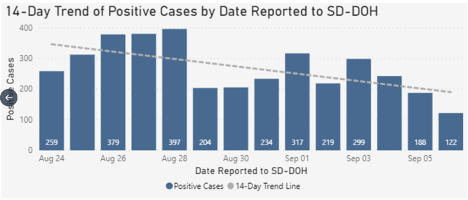
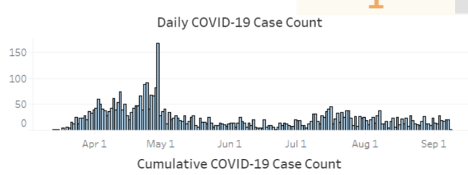
It is true that South Dakotans appear to obey the natural laws of viral spread.  As people gather and socialize doing the things they value, whether that be at motorcycle rallies or the local Target, cases rise.  Two weeks after the Sturgis rally, South Dakota goes from seeing fewer than a 100 new cases per day to almost 400 new cases per day.

To put these numbers into context, one need only look at the rise in cases in California, Washington and Florida, all seemingly quiet until a few weeks after massive gatherings in major cities during the Memorial Day Weekend.

Fascinatingly the same researchers confident about the link between national superspreading and the Sturgis Rally also found no link between widespread Memorial day protests and a spike in cases 2 weeks later. 

The data in early September, almost one month after the Sturgis Rally actually suggests S. Dakotans had a reasonably small uptick in cases that was already beginning to dissipate according to the snapshot available from the South Dakota COVID dashboard.

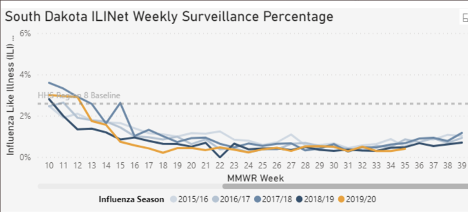
And its not just PCR positivity, even the weekly influenza like illness reporting trends year-over-year, shows no significant spike compared to prior years.

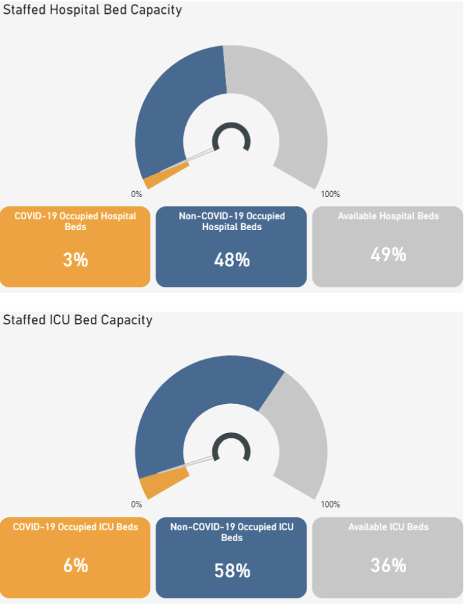
The danger of superspreader events is that they create a conflagration that overwhelms hospitals, yet the hospital occupancy data In South Dakota shows almost 50% of regular hospital beds, and 36% of ICU beds were empty one month after the Sturgis Rally.

The real meat in this scholarly work, of course, is the proposition that Sturgis spread the virus far and wide.  The paper sought to demonstrate this by by showing counties across the country that contributed a high number of attendees to the Sturgis Rally saw higher rates of COVID spread in the weeks that followed. 

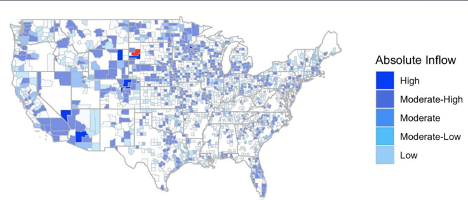
The following national map shows the counties that were noted to contribute a high number of travelers to the sturgis rally.  The deepest blue are high inflow counties, that were found to have an increase in cases between 6-12% after the Sturgis Rally.  Conversely, low inflow counties appeared to have no increase in new COVID cases.

This would appear to be concerning, visual evidence of COVID spread directly as a result of the Sturgis rally, until one actually uses the nice map to take a look at outbreaks in high inflow counties.  Here is one of the graphs of COVID cases in the deep blue high inflow Weld County, Colorado.  Even an electron microscope wouldn’t be able to manufacture a meaningful spike three weeks after the Sturgis even in early August..

Weld County, Colorado

The next high inflow county of interest is the home of Las Vegas, which also shows absolutely no visual evidence of chaos unleashed after the August gathering. The spike in cases here instead seems to time out well with casino openings in mid June.

Clark County, Nevada

Campbell County, Wyoming, another high inflow county, is perhaps more promising for the Sturgis superspreader narrative on first glance.  There appears to be a spike in cases about 2 weeks after Sturgis, but a closer look at the y-axis shows the spike in cases was 8 new cases in one day.  Not 80, not 8000, but eight cases.

Campbell County, Wyoming

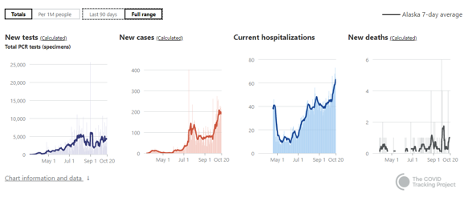
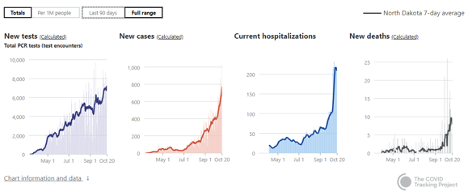
But as cases rise across the nation in October in multiple disparate states, somehow the edifying narrative the Washington Post and other social media influencers are latching onto is that the Sturgis rally was the unique event that set fire to the midwest. Never mind that non-contiguous Alaska and Sturgis-adjacent North Dakota have new case/hospitalization peaks that appear to mirror each other by both accelerating in October, well after one would expect Sturgis to be responsible. 

Alaska

North Dakota

On the other hand, Hawaii appears to have some cause to blame its epidemic on the irresponsible Dakotans from Sturgis based on the timing of its new case and hospitalization peaks.  It’s just too bad motorcycle traffic between Hawaii and South Dakota is of the non-existent variety.

Even casual observers at this point should realize that Science is in the process of being shaped by politics. Perhaps this has always been so, and it just took COVID to make the contortions transparent.  Nonetheless, we live in a world where the answers are known before the research begins and the headlines are written before journalists put pen to paper.  This goes well beyond the garden variety cherry picking of research that is the hallmark of all debates, whether they be scientific or political.  This is utilizing the research enterprise to manufacture science that suits a particular politic. And so we get a particular focus on Sturgis two whole months after the event because the point is to shame deplorables in states with Republican leadership 3 weeks before a Presidential election.  In this brave new world, the science tells us that massive Memorial Day protests don’t trigger viral outbreaks, but motorcycle rallies in South Dakota do.  “Science” careens towards science fiction. 

Anish Koka is a cardiologist in Philadelphia.  He is co-host of the Accad & Koka report.  Follow him on twitter @anish_koka.


from The Health Care Blog https://ift.tt/31LxpVT
via IFTTT

Thursday, October 22, 2020

Not Just Faxes

By KIM BELLARD

I missed it when it was first announced in Japan, but fortunately the U.S. mainstream media has finally picked up on the story, with articles in both The Washington Post and The Wall Street Journal: Japan’s new Administrative Reform Minister Taro Kono has “declared war” on fax machines, among other paper-based traditions. 

Wait, what?  “Administrative Reform Minister?”  The U.S., or at least the U.S. healthcare system, has to hear about this. 

Mr. Kono is a well known Japanese politician, including stints as Defense Minister and Foreign Minister.  He is thought of as something of a maverick, at least by Japanese political standards.  New Prime Minister Suga installed Mr. Kono in mid-September, making overhaul of bureaucracy a top priority: “Wherever there are problems, I want all of them brought to Mr. Kono for handling on behalf of the nation.” 

Mr. Kono set up a hotline for people to report government red tape, which was quickly overwhelmed with thousands of examples.  It soon reopened.

It didn’t take long for Mr. Kono to start calling for significant changes.  “To be honest, I don’t think there are many administrative procedures that actually need printing out paper and faxing,” he said in a press conference in late September.  “My job is to clear the road of obstructions to allow the Ferraris and Porsches of digital innovation to speed through.”

I wonder what Honda and Toyota thought about that.

Part of the problem in Japan is the hanko, a personal stamp that is routinely used for authentication (and which thus requires paper.)  He’s now at war with that as well, tweeting:

We checked 800 most often used government procedures with hanko, or name stamp or seal, and found few of them need to continue with hanko. This is the first step to make those procedures online.

One ally, futurist Morinosuke Kawaguchi, pointed out:

More than 97 per cent of the documents that are produced in companies and government offices presently need a hanko, but these are hanko that can be purchased in a convenience store, so there is no meaning to this habit.  It makes no sense, it’s completely ridiculous.

If you’ve ever envied Japan for its bullet trains, its early adoption of robots, or its broad use of consumer electronics, you may be surprised to hear that more than 95% of Japanese businesses still use faxes, and 34% of Japanese households have a fax.  Mr. Kawaguchi admitted: “It may be 1970s technology, but it is extremely secure and very difficult for someone on the outside to hack…Digitisation may make things more efficient, but there is clearly a trade-off when it comes to security.”

Jonathan Coopersmith, a Texas A&M professor who is an expert on faxes, told WaPo:

The primary mode of writing is by hand, and this is a technology that fits this perfectly.  One of the reasons it’s still there is that you have an older generation that’s never really wanted to use computers, and a lot of small businesses that never adopted computers and didn’t need to.”

Not surprisingly, the COVID-19 pandemic has been a big driver in the anti-fax initiative.  Health care professionals were overwhelmed by the amount of reports that had to be prepared by hand and then faxed.  “Come on, let’s stop this already,” one physician tweeted.  “Even with corona, we’re handwriting and faxing.”  Mr. Kono quickly retweeted it, even though he was still in his former position as Defense Minister – and within a week the health ministry announced a system of online filing (which, not surprisingly, has not entirely succeeded).

An independent report on Japan’s response to the pandemic found that their system “made it difficult to grasp the spread of infection in real time nationwide, and exhausted health center staff.  The new coronavirus crisis was also Japan’s ‘digital defeat.’”

We don’t have hankos in the U.S., and we’re not as reliant on faxes as Japan is, even in our healthcare system.  But red tape, inefficiencies, and antiquated technology?  Yeah, we’ve got all that, especially in healthcare.  But where’s our Secretary of Administrative Reform?  Where are our Chief Administrative Reform Officers? 

Heck, where are our hotlines to report red tape? 

Even now, well over six months into our pandemic response, we have a slapdash, state-by-state (or even county-by-county) system of reporting, with hospitals and HHS still struggling to figure out what and how to report.  We’re driving by looking in our rearview mirror, and images – data — may be distorted.  They certainly aren’t real-time.  Dr. Ashish Jha, director of Harvard’s Global Health Institute, lamented: “The CDC during this entire pandemic has been two steps behind the disease,”

“We are woefully behind,” one senior CDC official said.  She likened the state of U.S. public health technology to “puttering along the data superhighway in our Model T Ford.”  Where are those Ferraris and Porsches Mr. Kono is expecting? 

And, to be fair, it’s not just the U.S.  Jen Spahn, Germany’s federal minister of health, admitted:

Faxes are still the most used way of communication in our health system, at least when it comes to communicating between the different players.  Within a hospital, that might be very much digitised, but as soon as you want to communicate with another hospital or another player in the healthcare system, it’s very much like the 1990s and not like 2020.

Yoshimitsu Kobayashi, chairman of Mitsubishi Chemical Holdings, sees the pandemic as an opportunity: “The very negative damage it has inflicted on Japan has in turn served as a powerful accelerator.  If we miss this chance, we won’t be able to do it next time.”

Economist Paul Romer is usually credited with the quote, “A crisis is a terrible thing to waste.”  Well, we certainly have a crisis, and I’m worried we’re going to waste it.  Using it to just get rid of faxes would be a waste.  We’re already using it to streamline development of therapeutics and vaccines, although not without problems.  But will we use it to solve fundamental problems in our healthcare system, such as inequities, inefficiencies, and infrastructure? 

Maybe we could recruit Mr. Kono to do the job. 

Kim is a former emarketing exec at a major Blues plan, editor of the late & lamented Tincture.io, and now regular THCB contributor.


from The Health Care Blog https://ift.tt/3dM1BVM
via IFTTT

THCB Gang Episode 29 10/22 1PM PT/4 PM ET

Episode 29 of “The THCB Gang” will be live-streamed on Thursday, October 22th! Watch it below!

Matthew Holt (@boltyboy) will be by some of our regulars: patient safety expert Michael Millenson (@MLMillenson), MD turned leadership coach Maggi Cary (@MargaretCaryMD), guest Fard Johnmar (@fardj), digital health futurist, and guest Denise Pines (@MedBoardOfCA), Medical Board of California’s President. The conversation will cover the looming election, the ACA hanging by a thread, and more!

If you’d rather listen to the episode, the audio is preserved as a weekly podcast available on our iTunes & Spotify channels — Zoya Khanproducer


from The Health Care Blog https://ift.tt/3jowQHw
via IFTTT

Wednesday, October 21, 2020

THCB Book Club, October: Mike Magee, Code Blue

Dr. Mike Magee has spent his life inside the medical-industrial complex, eventually working at Pennsylvania Hospital and later becoming the doctor who sold Viagra to the world at Pfizer. He’s also an award winning medical broadcaster and historian who appears regularly on THCB these days. For the October THCB Book Club Jessica DaMassa and Matthew Holt had Mike on to discuss Code Blue — his magnum opus on how the American system become the medical-industrial complex that it is, the part he played, and what we might do to fix it! A fascinating and rich discussion.


from The Health Care Blog https://ift.tt/3jsCmcp
via IFTTT

Tuesday, October 20, 2020

#Healthin2Point00, Episode 160 | Lawsuits galore, and a faux IPO

The thing to do in health tech this week? Trademark infringement. Today on Health in 2 Point 00, we try to make sense of all the lawsuits right now with Teladoc suing Amwell, Allscripts suing CarePortMD, and whose side are we on for Zocdoc suing Zocdoc? On Episode 160, Jess asks me to make sense of Augmedix’s faux IPO in a reverse merger and publicly traded company Newtopia arising $75 million. Twentyeight Health raises $5.1 million in a Series C and TestCard raises $5.8 million for at-home mobile urine testing. —Matthew Holt


from The Health Care Blog https://ift.tt/35i4f1G
via IFTTT